In 1991 I wrote programs in LISP. For the uninitiated, LISP was the language of artificial intelligence, back when AI meant a professor, a chalkboard, and a machine the size of a Maruti 800 that could, on a good day, tell a cat from a chair. AI and I go back thirty-five years. It just took that long to return my call.
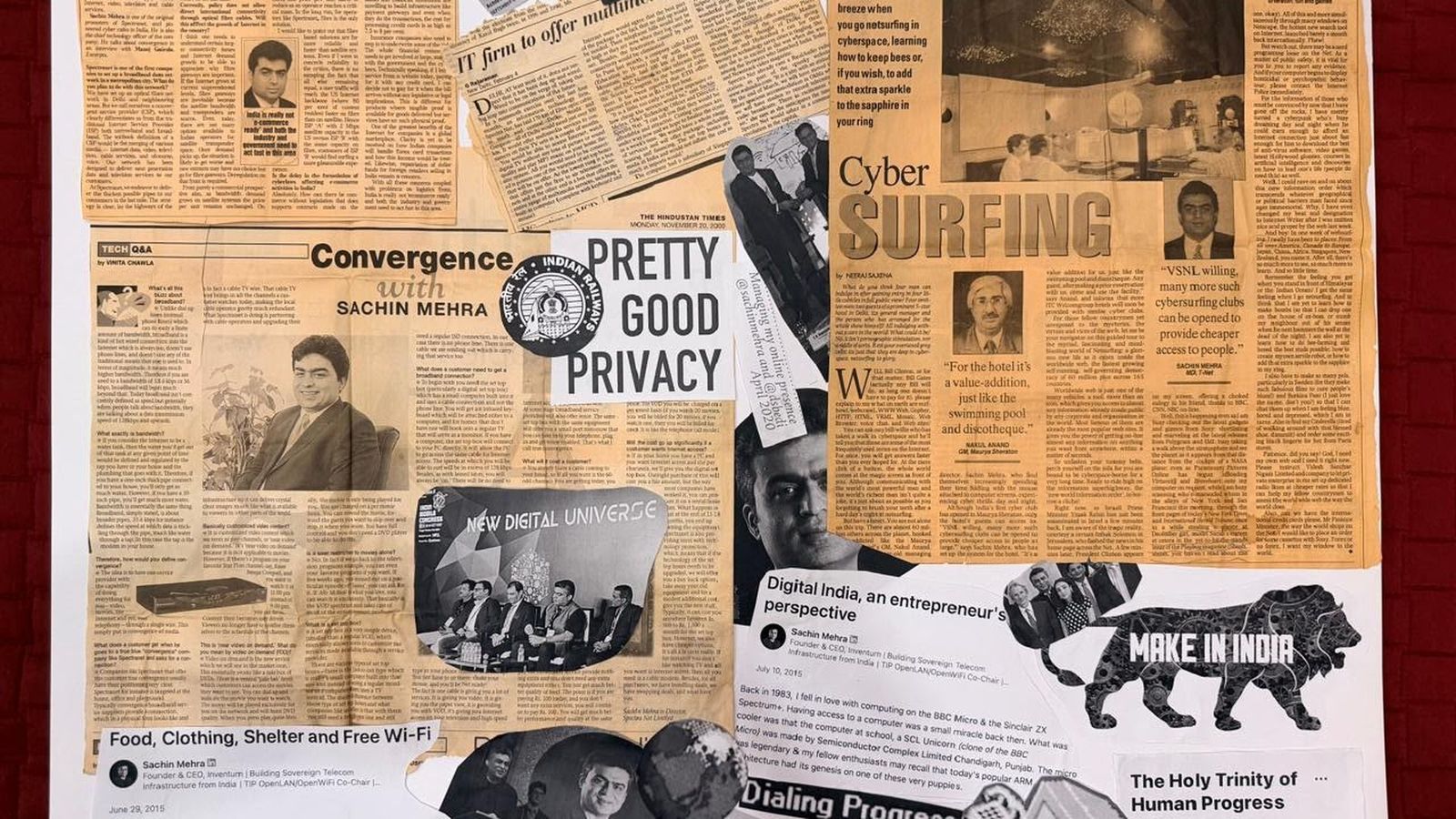
In between, my career became a list of firsts: India's first public Internet access, its first fibre to the building, the first Indian customer for Juniper's M20. Then I built one of the only carrier-class routers to come out of India, and the telecom software systems that run alongside it. I've written about that past, twice, in 2015.
This piece is about now, and what's next. Because at fifty-four, with no code written since the Vajpayee government, I went back to building. And I learned that old dogs don't just learn new tricks. We learn them faster, because we already know which tricks matter.
Kitne Prompts The?
It started with a decree. AI coding tools, mandatory, effective immediately. Twenty engineers said yes sir, then did what Indian teams have done to decrees since the Mughals. They waited for me to forget.
They weren't lazy. They were frightened. Every headline said AI would replace programmers, and here was the boss beaming like a man who had just found a cheaper one. No decree was going to fix that. So I decided to show the younglings by example.
Then Claude did something I hadn't planned for. It took the syntax off my hands entirely. I didn't stop coding twenty-five years ago because I stopped loving the problems. I stopped because I couldn't stand the semicolons. Now the semicolons were someone else's job. What was left was the algorithm, the trade-off, the shape of the solution. The part I'd always been good at. The part I'd been paying other people to do.
Old Dogs Have Dug Trenches
Here's what Gen Z brings: fluency. They were born with a model in their pocket. Here's what they don't bring, yet: not one of them has built a router, dug a trench, or pointed a satellite dish at the right bit of sky.
The first horizontal directional drilling machine in India was a Ditch Witch, and it was mine to command. We bored a fibre route from Nehru Place to Okhla Phase 3 overnight, under the road, without opening a single trench. The right of way cost us one rupee. I have never closed a better deal, and I've closed a few.
I've dug trenches for fibre, laid submarine cable, hung off poles pulling coax for cable TV and DOCSIS, built metro Ethernet, and watched ATM, WiMAX and TDM rise, strut, and die. I saw GSM lift whole countries. I've worked on MCU, CPU, ASIC, FPGA, NPU and now GPU, from when NVIDIA was a graphics card company. I sold TCP/IP stacks from FTP Software when the Internet was a university hobby, and distributed RSA tokens when public-key encryption was considered exotic. I've fought cyber attacks. I remember when any .com you wanted was available. And I'm scratching the surface.
None of that is nostalgia. It's the brief. Every scar is a thing I know the customer will complain about before they do. When knowledge is democratised, the only thing left to sell is judgment, and judgment is made of scar tissue. White hair, for once, is a feature.
Driving Lessons at 54
Learning this at fifty-four is like getting back behind the wheel after twenty-five years of being chauffeured. You know every shortcut in Delhi. You have opinions about the route. You just can't remember which side the indicator is on, and the car keeps telling you off.
My first mistake was treating the model like a colleague with a memory. I'd spend an evening with it designing a module, go to bed pleased with myself, and come back the next morning to find it had no idea who I was or what we'd agreed. Like a brilliant consultant who bills you for the briefing every single day. I blamed the model. I switched models, three times. The models were fine. The problem was that in twenty-three years of running a company on verbal instructions, I had never written anything down, and a machine was the first employee to call me on it. Now every project has a one-page note: who we are, what's decided, what never to do. The team, it turns out, had wanted that note for years.
My second mistake was assuming our own data was clean. I set a model loose on two decades of customer records we were moving off a rented platform, expecting a tidy migration. Within minutes it reported, politely, that we had sold several devices in the year 2103. A typo, repeated across a batch, that had sat in our systems for a decade. Nobody had noticed. Nobody had looked. That's when I understood what these things are good for: not replacing judgment, but applying it tirelessly, to every row, at three in the morning.
And somewhere past midnight, looking at something that actually worked, I caught myself grinning. The boy with the LISP manual had never left. He'd been stuck in a very long board meeting.
Horses for Courses
People ask which AI models and tools I use. It's the wrong question, the way asking a builder which brand of hammer he swings is the wrong question. He owns several. What matters is knowing which one the job in front of him needs. So, horses for courses.
The frontier models I use mostly to stay abreast. Fable and Opus when I'm thinking about architecture. Sonnet for the grind. Gemini, Kimi K3 and Astra to keep the others honest. I've tried every one with a name. Don't marry a model. Date them all, and keep notes.
Anything that must stay on the device or on the premises runs on Ollama with Qwen. In my business, with government and railway customers, that's most of it. A sovereign network cannot phone California to ask whether a port should be open.
Sitting between all of them is LiteLLM, a switchboard. Every request goes through it, and it decides which model picks up: the expensive one for a design question, a cheap local one for a lookup. It caches prompts so the same context isn't paid for twice, and it keeps the bill. My token spend dropped the month I installed it, which is more than I can say for any consultant I've hired.
LangChain is the plumbing for anything that takes more than one step: fetch the logs, summarise them, check the summary against the manual, draft the reply, ask a human before sending. A language model answers a question. LangChain turns a dozen answers into a job that finishes.
And AnythingLLM gave me what the industry calls RAG, retrieval-augmented generation. In plain words: before the model answers, it goes and reads the relevant pages first. I fed it twenty-three years of support tickets, manuals and field notes, and now a new engineer can ask “why does this gateway reboot at 2 a.m. on Tuesdays” and get the answer we wrote down in 2011, with the ticket number. The model didn't learn our business. It learned where we keep it.
Then there are the vision models. Moondream is small enough to run at the edge and look at a camera feed, which means every CCTV camera on the premises is now a sensor with opinions. I've built useful things with it. I've also built a thoroughly shameless thing: it watches our cameras and pings me when an employee appears to be wasting time. The employees have asked that it be pointed at my office.
We're discussing it.
And here's the part the hype merchants miss. Most of a network's intelligence should not be a language model at all. Deciding a channel, steering a client, spotting an anomaly: that's statistics and signal processing. Deterministic, explainable, cheap. The language model talks. The maths from the 1940s decides.
That's how we rebuilt the data planes for our MSG gateway and BNG line this year. Agents on the typing, maths on the decisions, me on the judgment. The CEO who enters one horse in every race is going to lose a lot of races.
Just Converse, and It's Done
All of that was practice for Udaya (dawn, in Sanskrit), the company my sons and I are building, and its product, Udaya Intelligence. I can't say much yet. I can say this.
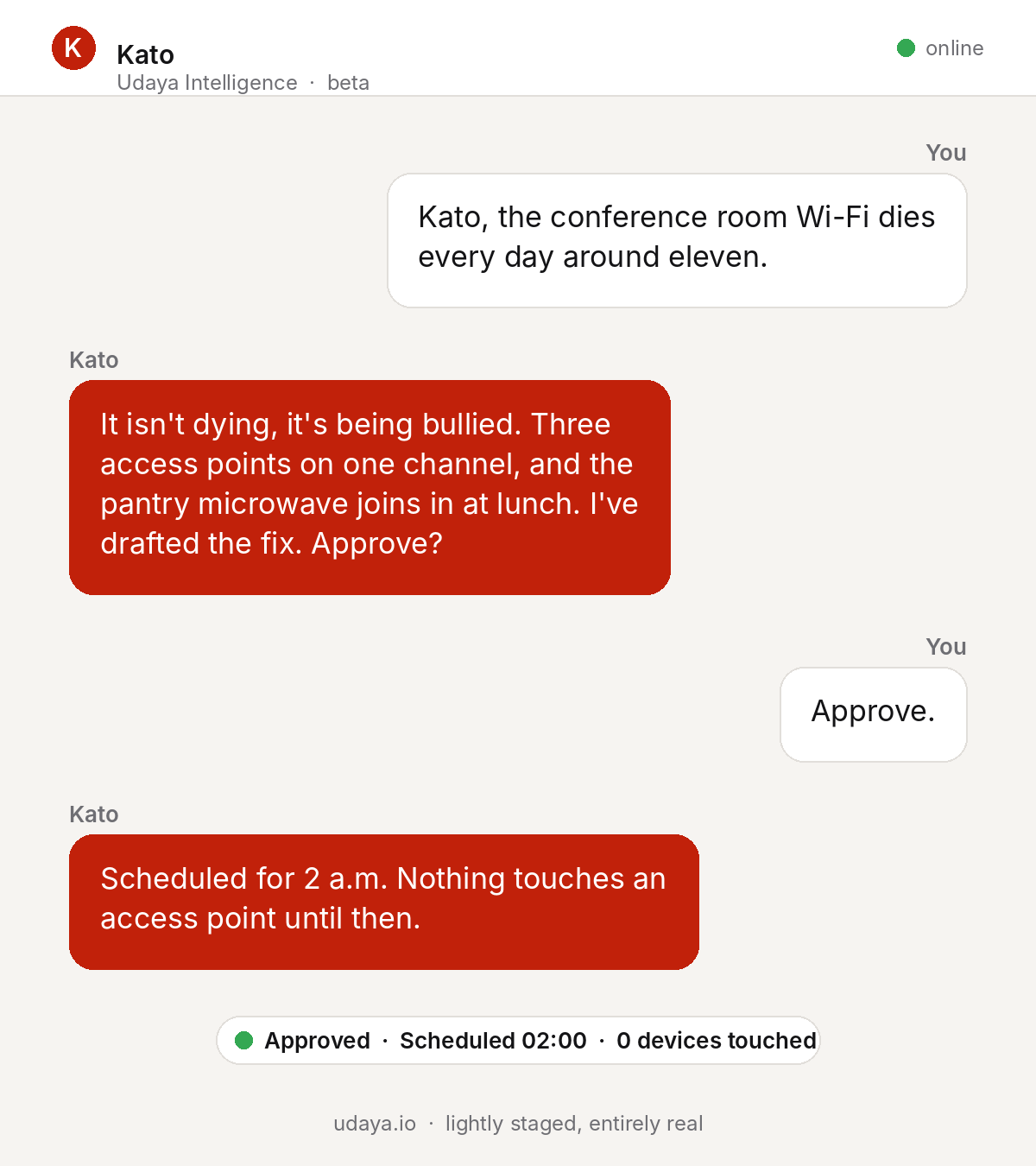
For thirty years, fixing a network meant a man, a laptop, a ladder, and a command line only he understood. We built a crew instead. Kato fronts the conversation; he's named for Inspector Clouseau's manservant in the Pink Panther films, who attacks the moment you walk in the door to keep you sharp. Bandit prices the risk. Markov projects what the network will look like after. Q runs the tools. A real exchange, lightly staged: